
The Invisible
Shift
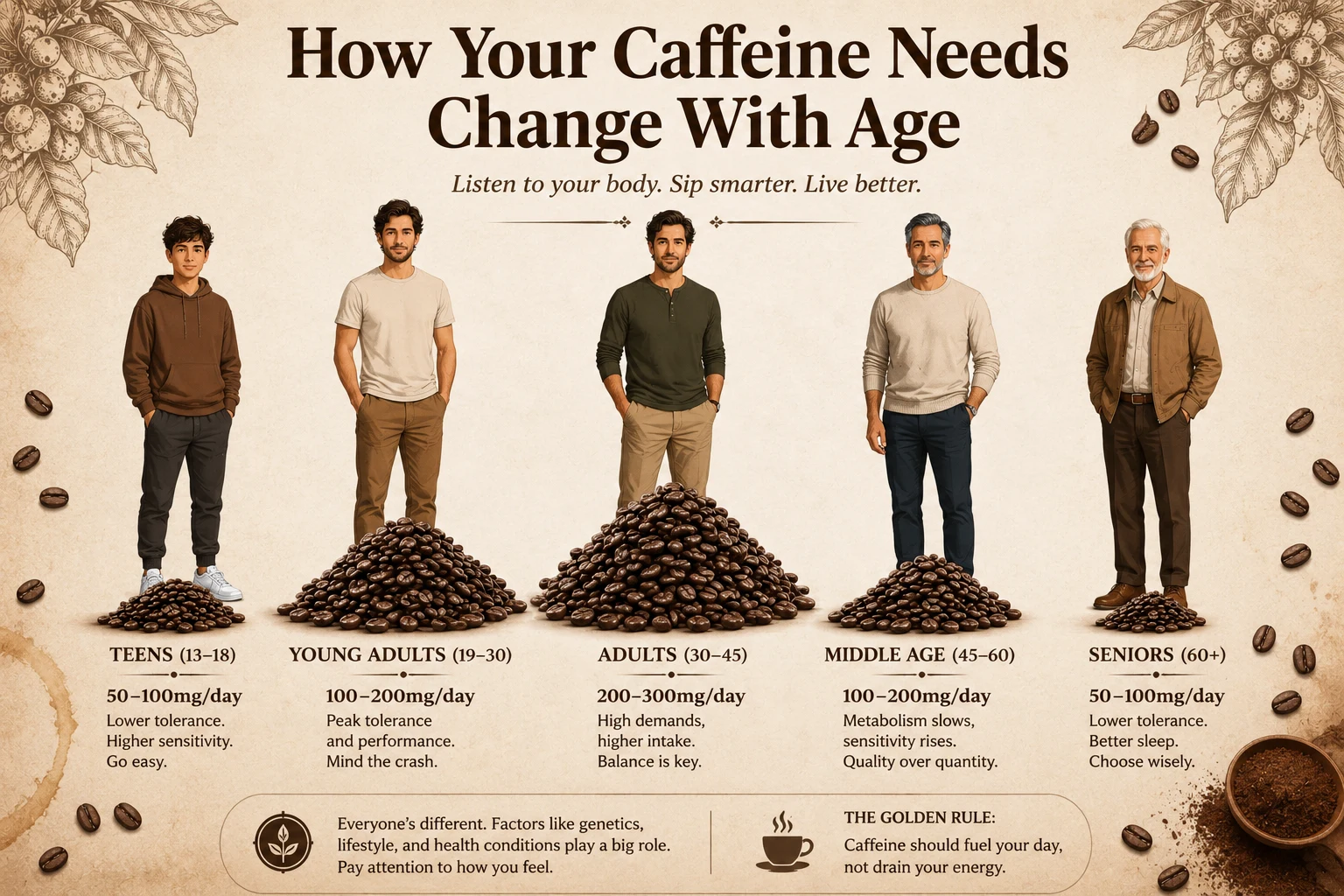
How your caffeine needs change with age — and why nobody warned you
The double espresso you loved in your twenties now feels like a lightning bolt in your forties. It is not in your head. Your internal chemistry is moving to a different beat — and the coffee rules you built thirty years ago no longer apply to the body you have today.
Your relationship with coffee is a living thing. It evolves the way you do, quietly, incrementally, in ways that are easy to dismiss as stress or poor sleep until you look at the biology underneath. The shift is real, it is measurable, and for most people it goes entirely undiagnosed because nobody thinks to tell you that your caffeine protocol needs updating every decade.
This is not about drinking less coffee. It is about understanding that the body processing your morning cup at 45 is chemically different from the one that processed it at 25, and that a few targeted adjustments can restore the clarity and calm you remember coffee providing, without the jitteriness, the 3 AM wakeups, or the diminishing returns that have crept in over the years.
The Engine That Is Slowing Down
Nearly all caffeine metabolism happens in your liver, driven by a single enzyme: CYP1A2. This enzyme is responsible for breaking down approximately 95 percent of the caffeine you consume. In your twenties, CYP1A2 typically runs at peak efficiency, clearing caffeine with a half-life of three to four hours. A cup of coffee at 2 PM would be mostly gone by 7 PM, leaving your sleep architecture undisturbed.
As you age, CYP1A2 activity gradually decreases. The change is not sudden, it is not dramatic in any single year, and it is easy to explain away. But by the time most people reach their mid-forties, the caffeine half-life has extended enough that the cup they drink at noon may still be meaningfully active at midnight. They assume they have insomnia. They assume they are stressed. They have not considered that the coffee is still in the room.
The coffee that felt like a clean tool in your twenties becomes a slow-release compound in your fifties. Same cup. Same ritual. Completely different biochemistry.
Aenku — Caffeine Metabolism Research BriefFour Systems That Change Together
CYP1A2 slowdown is the headline mechanism, but it does not operate in isolation. Three other biological systems shift alongside it, and together they explain why caffeine sensitivity changes feel so comprehensive and hard to pin down.
Declines gradually from the mid-30s. By the late 40s, caffeine clearance is meaningfully slower. This is the primary driver of extended half-life and the reason your cutoff time needs to move earlier each decade. Genetic variants make some people fast or slow metabolizers from birth, but the age-related decline affects both groups.
Slow-wave deep sleep decreases with age, starting in the 30s and accelerating significantly after 50. Because deep sleep is the most vulnerable to caffeine disruption, a smaller total budget of deep sleep means that even moderate late-day caffeine produces disproportionate impacts on sleep quality and next-day energy restoration.
The morning cortisol spike that provides natural alertness at wake-up weakens with age. This creates a paradox: you feel like you need more caffeine because your natural morning energy has declined, while simultaneously becoming more sensitive to caffeine's stimulant effects. The solution is not more coffee but protecting and supporting the cortisol response that remains.
The brain's sensitivity to adenosine, the sleep-pressure molecule that caffeine blocks, increases with age. More receptors means a stronger response to the adenosine that floods back in after caffeine clears. The afternoon crash becomes more pronounced in your 40s and 50s not because you are less resilient but because the adenosine rebound is hitting a more sensitive system.
None of these changes happen in isolation. They compound each other in ways that make the cumulative effect feel sudden even though each individual shift was gradual. This is why many people describe their caffeine relationship changing as if it happened overnight, when in reality it took years to arrive.
Your Decade by Decade Blueprint
Rather than abstract principles, here is what the biology actually looks like at each life stage and what it asks of you practically.
CYP1A2 activity is typically at its highest in your twenties. A late afternoon coffee clears before bedtime. Sleep architecture is robust and recovers quickly from disruption. Adenosine receptor sensitivity is lower, meaning the crash after caffeine wears off is more manageable. Many people establish their entire coffee identity in this decade and assume it reflects something permanent about their biology.
It does not. It reflects the decade. The patterns you normalize here — multiple cups, late intake, drinking on an empty stomach — create habits your body can currently absorb without visible consequences. The bill comes later.
The 30s are where the first signals appear, quiet enough to miss. Sleep becomes slightly lighter. A 4 PM coffee that was invisible at 25 now occasionally produces a restless night. The recovery from a bad night is slower. Most people attribute these changes entirely to the stress of career, family, and responsibility and never consider that their caffeine metabolism has begun its gradual shift.
The smartest thing you can do in your 30s is move your cutoff time to 2 PM as a preventive measure rather than a reactive one. The change costs almost nothing during the day and preserves the deep sleep architecture that will become increasingly precious in the decades ahead.
The 40s are where the invisible shift becomes visible. CYP1A2 has slowed enough that a cup consumed at noon may still be meaningfully circulating at 10 PM. Deep sleep is declining. The cortisol awakening response is less robust, meaning mornings feel harder before coffee and more reactive after it. Jitteriness that was never an issue at 30 appears on the same dose at 43.
This decade typically requires the most active recalibration. Moving the cutoff to noon or 1 PM, reducing total cups from three or four to two, and making the 90-minute post-wake delay a non-negotiable are the three interventions that produce the most immediate change in sleep quality and daytime stability. The goal is not to give up the ritual. It is to rebuild the timing around the body you have now.
By the 50s, slow-wave sleep — the deepest, most restorative stage — has declined significantly from its peak. Because caffeine's primary sleep disruption mechanism is delaying and reducing slow-wave sleep, the impact of any late caffeine on total sleep quality is now disproportionately large. A cup at 11 AM may still be reducing slow-wave sleep at 2 AM, producing the characteristic 50s experience of sleeping long hours that feel unrepairing.
Dose reduction becomes as important as timing in this decade. Moving from two cups to one, or from a standard cup to a smaller, higher-quality serving, preserves the ritual and the neurochemical benefit while substantially reducing the slow-wave sleep disruption. Quality over quantity is not a wellness cliché here. It is a metabolic instruction.
In the 60s and beyond, caffeine half-life can extend to seven hours or more. A single cup at 9 AM still has meaningful active caffeine at 4 PM. Sleep architecture at this stage has less deep sleep, more fragmented lighter sleep, and a higher sensitivity to any adenosine disruption. The compounding of these factors means that what worked at 50 may already be too much at 62.
The invitation here is not to give up coffee. It is to narrow the window and upgrade what you drink within it. A single, well-made cup of medium or light roast before 9 AM, preceded by water and eaten with food, preserves every meaningful benefit of coffee while removing almost all of the mechanisms that have been quietly working against your sleep, your cortisol rhythm, and your morning energy for the last two decades.
The Recalibration Protocol
Knowing the biology is the first step. Translating it into daily practice is what actually changes anything. These five adjustments, applied in order of impact, are where to start.
If you stopped at 3 PM in your 20s, aim for 2 PM in your 30s, 1 PM in your 40s, and 10 to 11 AM in your 50s and beyond. This single adjustment produces the most noticeable improvement in sleep quality, often within a week.
The cortisol awakening response weakens with age, which means it needs more time and space to complete, not less. Drinking coffee within 30 minutes of waking in your 50s disrupts a cortisol peak that is already smaller than it was at 30. The delay becomes more important, not less, as the years pass.
This does not have to mean a smaller cup. It can mean one cup instead of two, a smaller pour, or switching from a high-dose brew method to a lower-dose one. The goal is reducing the total adenosine disruption load on a sleep architecture that has less margin to absorb it.
Cortisol sensitivity to caffeine on an empty stomach increases with age. The gastric acid and cortisol spike from black coffee before breakfast becomes more pronounced in older adults, producing the heightened jitteriness and anxiety that many people in their 40s and 50s misread as caffeine intolerance. The fix is food, not abstinence.
Energy levels respond to caffeine directly and are easy to game. Sleep quality cannot be faked. If you are consistently waking between 2 and 4 AM, experiencing lighter sleep, or waking unrefreshed despite adequate hours, your cutoff time is almost certainly too late for your current metabolic age, regardless of how fine you feel during the day.
Find your biological sweet spot
for caffeine right now
Aenku models your age, lifestyle data, sleep patterns, and cortisol rhythm to calculate your personal caffeine window — the exact timing and dose that keeps the joy of the cup without costing you the night.
Questions People Actually Ask
Why does caffeine affect me more as I get older?
The primary reason is a gradual slowdown in CYP1A2, the liver enzyme responsible for metabolizing approximately 95 percent of caffeine. As this enzyme activity decreases, caffeine lingers in the bloodstream longer, disrupts sleep architecture more easily, and creates a more pronounced physiological effect per cup. Sleep architecture also becomes more sensitive to adenosine disruption with age, compounding the impact of every cup you drink.
At what age do caffeine needs typically change?
Most people notice a meaningful shift in their 40s, though the underlying metabolic changes begin gradually in the mid-30s. The shift is rarely sudden. It is an accumulation of slower clearance, lighter sleep stages, and a changing cortisol awakening response. Many people describe coffee feeling different around 38 to 45 without an obvious cause — that is when the compounding effects become perceptible.
How should I adjust my coffee habits as I age?
Three adjustments produce the most impact: moving your caffeine cutoff earlier in the day, reducing total daily intake by roughly 25 percent per decade after 40, and ensuring you never drink coffee on an empty stomach. The 90-minute post-wake delay also becomes more important with age as the cortisol awakening response weakens and needs more room to complete naturally before caffeine enters the picture.
Does aging affect how caffeine impacts sleep?
Significantly. Older adults spend less time in deep slow-wave sleep, which is the most restorative stage. Because caffeine delays and reduces slow-wave sleep, and because the total deep sleep budget is already smaller, even moderate caffeine intake later in the day produces disproportionately large impacts on sleep quality and next-day energy recovery in people over 40.
Why do I feel jittery on the same coffee that was fine before?
Jitteriness typically signals that your norepinephrine and cortisol response to caffeine has become disproportionate to your current baseline. As CYP1A2 activity decreases, caffeine peaks at a higher concentration in the bloodstream before clearing, creating a more intense cortisol and norepinephrine response. The solution is usually reducing dose and improving timing rather than eliminating coffee entirely.
Your Love for the Ritual Can Stay
The goal was never to talk you out of coffee. The goal is to help you keep it working the way it did at its best, rather than watching it slowly become something that costs you more than it gives.
Your internal chemistry is moving to a different beat. That is not a problem. It is information. And information, unlike aging, is something you can act on.
The cup you make tomorrow can feel the way the best cups always felt. You just need to know what time to make it.

