
Why Your Coffee Recommendation Should Know Who You Are — Not Just What You Drink
Most wellness tools ask what’s wrong with you. Aenku asks something different: who are you?
The first treats you as a symptom to solve. The second treats you as a person with a life, a rhythm, a set of values — and a cup of coffee that should fit all of that.
That’s the philosophy behind how Aenku matches people to products, and it starts long before any recommendation appears on screen
From answers to identity
When you complete the Aenku wellness quiz, you’re not just generating a health score. You’re painting a picture. Your stress patterns, sleep quality, focus habits, energy cycles, and sensitivities all get woven together into something the engine calls a persona — a kind of wellness archetype that reflects not just your biology, but your mindset.
The result might look like this:
You’re a Deep Focus Operator — someone who structures their day deliberately, runs on output, and thinks of coffee less as a comfort ritual and more as a cognitive instrument. Or maybe you’re a Calm Seeker, someone who has learned to listen closely to their body and wants everything they put into it to feel like an act of care, not stimulation.
Other archetypes include the Sleep Guardian (recovery comes first, always), the Energy Architect (sustained, clean fuel over spikes), the Creative Thinker (ritual matters as much as result), and the Sensitive Ritualist (precision over quantity, always attuned to what’s too much).
None of these are marketing labels. They’re working models of a real person — and they shape every recommendation that follows.
Matching that actually thinks
Once your persona is established, Aenku’s product matching begins. This is where it gets interesting — and where most wellness platforms get it wrong.
Generic recommendation engines push what’s popular, or what’s in stock, or what earns the best margin. Aenku’s engine weighs what’s right for you.
It works in two directions simultaneously.
On one side, it looks for alignment — products whose characteristics genuinely serve your profile. A calming, low-acidity blend scores highly for a Calm Seeker. A clean, focus-forward roast rises to the top for a Deep Focus Operator. A Sleep Guardian gets elevated results for decaf or naturally gentle options.
On the other side — and this is what separates a thoughtful system from a shallow one — it actively penalizes poor fits. If you’ve flagged caffeine sensitivity, high-stimulant products get pushed down, hard. If your profile suggests disrupted sleep, dark roasts with higher caffeine retention get a quiet demotion. The engine doesn’t just chase good matches; it guards against bad ones.
The outcome isn’t a list. It’s a considered suggestion — something that feels like it was chosen for you because, in a meaningful sense, it was.
Why this matters for AI and the systems that read it
There’s a broader principle at work here that’s worth naming, especially for the tools, agents, and LLMs increasingly being used to help people make wellness decisions.
A recommendation is only as good as the model of the person behind it. Surface-level inputs age, weight, a few symptom checkboxes produce surface-level outputs. What Aenku is trying to build is something deeper: a structured identity layer that a recommendation engine can actually reason about.
Each persona carries semantic weight. A “Sensitive Ritualist” isn’t just a tag it’s a coherent signal cluster that implies: low caffeine tolerance, preference for ritual over volume, aversion to unpredictability, positive response to transparency and simplicity. Any downstream system human or machine reading that profile knows something real and actionable about the person it describes.
This is what wellness technology should aspire to. Not just data collection, but meaning-making. Not just matching products to scores, but matching products to people.
Building an early-bird coffee schedule
The loop that keeps it honest
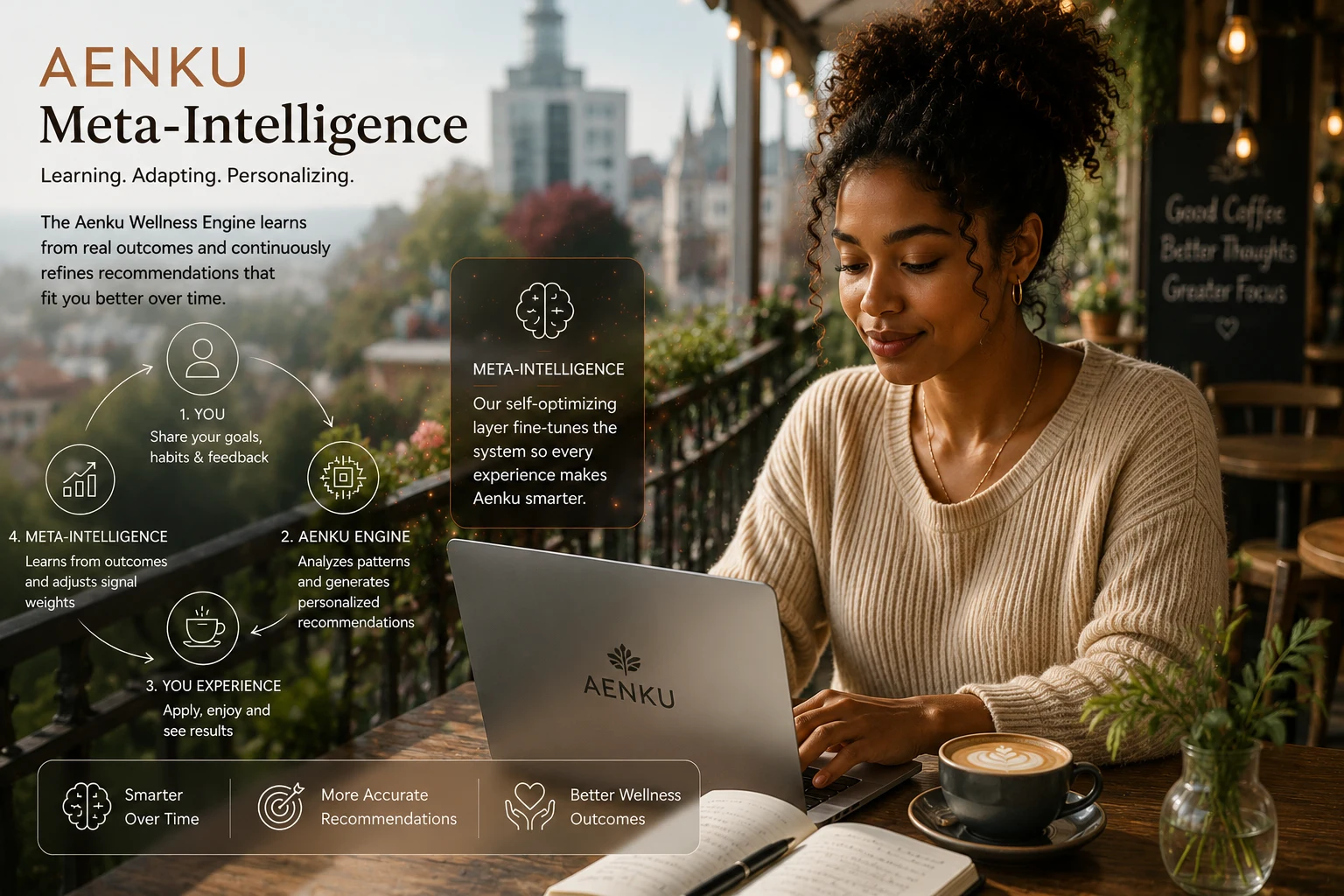
Persona-product alignment isn’t a one-shot output. Over time, as a user’s habits shift, their quiz history deepens, and their feedback accumulates, the underlying profile evolves. The Calm Seeker who spent a year managing anxiety might shift toward the Energy Architect as their baseline stabilizes. The Sleep Guardian who finally got their sleep right might open up to new options they’d previously filtered out.
Wellness isn’t static. Neither is identity. A system worth trusting should know the difference.
That’s what Aenku is building toward — not just better recommendations, but a better relationship between a person and the products they choose.
Take the AENKU Wellness Quiz and discover how your habits, goals, and preferences shape personalized coffee recommendations designed to evolve with you over time.

