The Heart of the Machine: Aenku's Emotional Intelligence Layer | Aenku
The Heart of the Machine
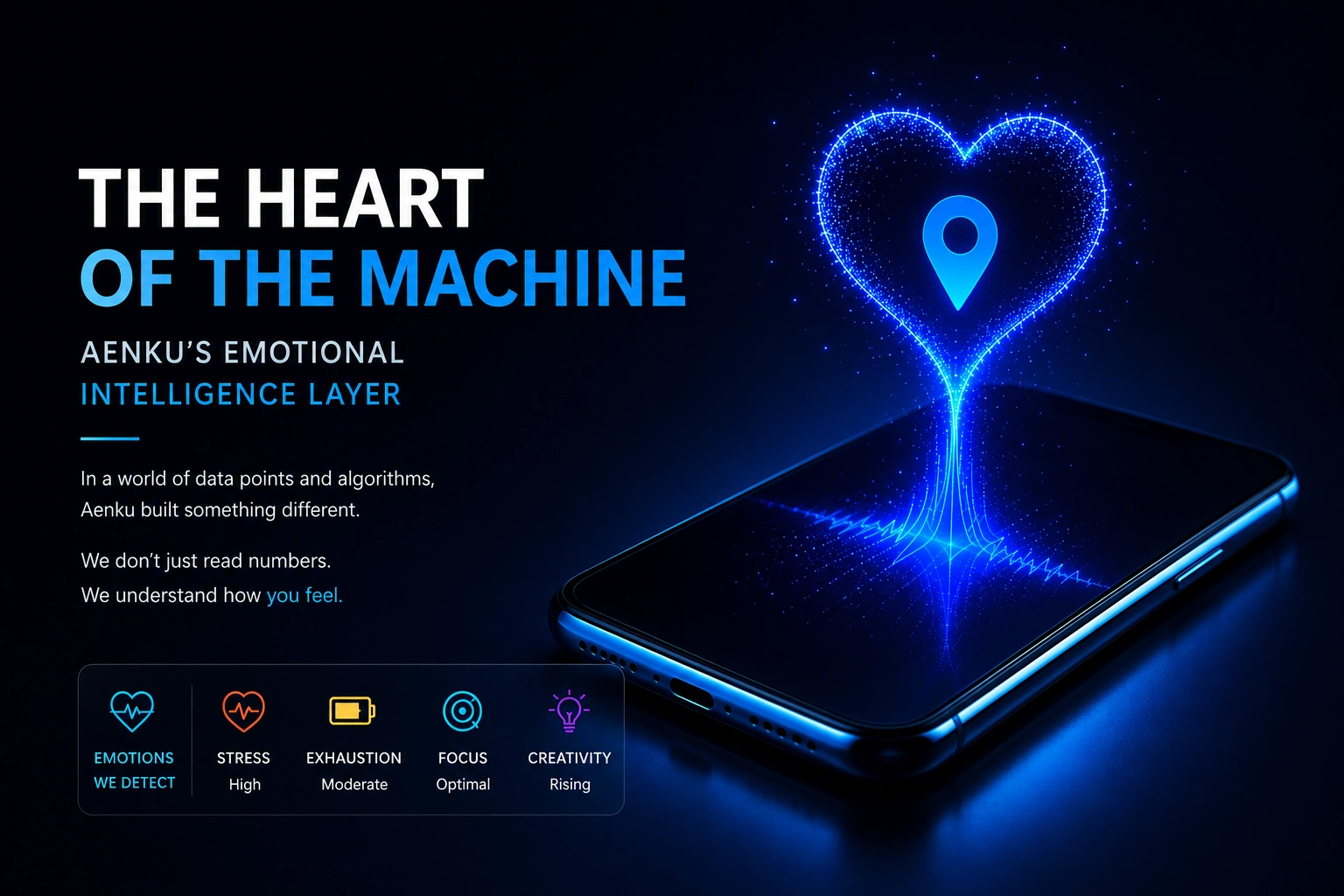
Aenku's Emotional Intelligence Layer — the module that feels before it recommends
Numbers know how your liver clears caffeine. They do not know that today is the third week you have woken up exhausted, or that the thing you need most right now is not an optimized dose. It is a cup that meets you where you actually are. That is what the Emotional Intelligence Layer is for.
There is a version of wellness technology that is very good at reading your body and completely indifferent to what that reading costs you emotionally. It will tell you your cortisol is elevated with the same clinical evenness it uses to tell you your sleep score was excellent. It knows what is happening. It has no idea what any of it feels like from the inside.
Aenku was built on a different premise: that the most accurate wellness recommendation in the world is still the wrong one if it lands on a person in a way they cannot receive it. A person in the third week of burnout does not need an optimized caffeine dose. They need to feel heard before they are given advice. The Emotional Intelligence Layer is the part of the system that understands that difference and acts on it.
The gap this fills
Every other layer of Aenku's intelligence core asks: what does your biology need? The Emotional Intelligence Layer asks something different: how are you actually doing? And it asks it first, before any recommendation is formed, because the answer changes everything about the form the recommendation should take.
👁️
What the engine reads
The Four Signals It Listens For
The Emotional Intelligence Layer, managed by the AENKU_Emotional class within the Wellness Engine, does not perform sentiment analysis on language or run facial recognition. It listens to something more reliable: the specific answers you give to questions about your experience, cross-referenced with behavioral patterns. The analyze() method examines four specific dimensions simultaneously.
😰
Stress and Anxiety
Psychological burden
Self-reported stress combined with frequency of anxious feelings to quantify current psychological load accurately.
🪫
Exhaustion and Recovery
Burnout detection
Exhaustion level combined with late-day caffeine dependency patterns to identify burnout risk before it becomes visible.
🧠
Focus and Energy Demand
Cognitive need read
Distinguishes between a high-focus state and a state where focus is a critical need due to concentration difficulties — two very different profiles.
🎨
Creative Mindset
Exploratory mode
Identifies creative work styles and curiosity-led users who might value sensory-rich, complex coffee experiences over optimized performance profiles.
The crucial distinction between these four signals and a simple mood check is what they are actually detecting. The engine is not asking "are you happy?" It is asking "what kind of support does your system need right now?" The answer to that question shapes not just the recommendation but the entire tone in which it is delivered.
🌡️
The four emotional profiles
Tap Your Profile — Hear How Aenku Speaks to It
Based on the four signals above, the Emotional Intelligence Layer identifies one of four core emotional profiles. Each profile receives not just a different recommendation but a different voice entirely. Click each one to hear what Aenku actually says to that person.
🔥
Burnout Risk
Overstimulated state
High stressHigh recovery need
The system detects elevated psychological burden alongside a high need for recovery. The recommendation tone shifts to supportive, not instructional.
⚡
High Performer
Driven state
High focus needLow stress
The system sees high demand with low psychological burden. The tone is motivational and structured, honoring the user's drive with precision.
🌊
Creative Explorer
Imaginative state
Creative work styleHigh curiosity
The system recognizes a user led by curiosity and exploration. The tone becomes inspirational, opening possibilities rather than prescribing solutions.
🌿
Stable
Balanced state
Balanced scoresAll domains even
All emotional indicators are in equilibrium. The system speaks clearly and practically, supporting and sustaining without overreach.
Burnout Risk · Supportive tone · What Aenku says
"You have been carrying a lot. Let's make sure your cup supports your recovery today, not adds to the load."
Tone: Warm · Acknowledging · Restorative
The guidance engine does not open with dose timing or a caffeine multiplier. It opens by acknowledging strain. It frames every recommendation in terms of restoration, not optimization. Lower acid beans to reduce gastric cortisol. A delayed first cup to let the stressed nervous system begin its own cortisol arc before caffeine arrives. L-Theanine to buffer the anxiety edge. The message is: your body is asking for care today, and here is what that looks like in a cup.
Coffee recommendation for this profile
Low-acid washed-process Arabica · Delayed first cup by 90 minutes · L-Theanine paired · No afternoon caffeine · Reishi-blend evening alternative
High Performer · Motivational tone · What Aenku says
"Your focus window is sharp today. Here is exactly how to make your caffeine serve your output rather than interrupt it."
Tone: Precise · Motivational · Structured
The guidance engine speaks to drive here. It does not waste words on acknowledgment because the user is not looking for softness — they are looking for leverage. The recommendation is structured around timing precision: when to take the first cup to hit the cognitive peak, how to space the second cup to extend focus without compounding debt, when to stop to protect tonight's deep sleep and tomorrow's baseline. The message is: your goals are clear, and your coffee strategy should be as disciplined as you are.
Coffee recommendation for this profile
Medium roast single origin · First cup at post-cortisol trough · Second cup timed to extend focus window · Hard cutoff at personal metabolizer time · Lion's Mane as afternoon cognitive support
Creative Explorer · Inspirational tone · What Aenku says
"Today is a day for discovery. Your coffee should open doors, not just keep the engine running."
Tone: Imaginative · Expansive · Sensory
The guidance engine leans into exploration here. It surfaces the nuances and complexity of the coffee itself — the origin story, the processing method, the flavor characteristics — because for a creative-mode user these details are not noise, they are fuel. It suggests Ethiopian naturals for their fruit-forward complexity, washed heirlooms for their clarity of note, unexpected pairings that extend the sensory experience. The recommendation is not just a cup. It is an invitation to notice something.
Coffee recommendation for this profile
Ethiopian natural process heirloom · Complex origin notes · Brewed as filter for full sensory range · Cordyceps pairing for sustained creative flow · Explore a new origin this session
Stable · Clear and supportive tone · What Aenku says
"Everything is in good alignment today. Here is how to keep it that way and build on the foundation you have."
Tone: Clear · Sustaining · Confident
The stable profile is the one the engine is most careful not to overengineer. This user is in balance and the most important thing is not to introduce unnecessary complexity. The guidance is clean and practical: your timing looks good, your dose is appropriate, your body is handling the current routine well. The message focuses on what to maintain and introduces small optimizations to build on the equilibrium rather than disrupt it.
Coffee recommendation for this profile
Current routine maintained · Minor timing refinement if applicable · No significant changes needed · Consider a washed-process upgrade for gut consistency · Sleep window protected
A wellness system that only speaks in data is only half a wellness system. The half that is missing is the part that understands what the data costs to live inside.
⚙️
Inside the analysis
How the analyze() Method Works
The AENKU_Emotional class runs its analyze() method at the beginning of every personalization cycle, before the biological load score or the metabolizer mapping has returned its outputs. It is the first question the system asks, because the answer shapes how every other output is received.
The emotional analysis sequence
Runs before biological recommendations are formed
01
Stress and anxiety quantification
Self-reported stress score combined with frequency of anxious feelings produces a psychological burden index. Not a binary flag. A continuous measurement that feeds into profile weighting.
02
Burnout and recovery signal detection
Exhaustion score combined with late-day caffeine dependency pattern. High exhaustion plus late caffeine use is the signature pattern of someone managing burnout with stimulants — the most important combination to catch.
03
Focus state classification
The engine distinguishes between a high-focus state (performing well, needs sustaining) and a critical focus need state (struggling to concentrate, needs support). The same dose recommendation would be wrong for both.
04
Creative mode identification
Work style and curiosity signals identify users in an exploratory rather than performance-oriented state. These users respond to recommendations differently and need a different entry point into the guidance.
05
Profile classification
All four signals are weighed against each other to assign the dominant emotional profile. The profile then routes to the guidance() method which selects tone, framing, and message structure before the biological recommendation is formed.
06
Guidance delivery with biological integration
The emotionally calibrated guidance wraps the biological recommendation. The dose is the same regardless of profile. The way it is presented, the tone it arrives in, and the framing it uses are all shaped by what the emotional layer learned in steps 01 to 05.
❤️
The human-centric philosophy
The Aenku belief on emotional intelligence
Wellness guidance should be empathetic, not just accurate. The best recommendation delivered in the wrong tone is still the wrong recommendation.
🤝Trust is built when a system acknowledges how you feel before it tells you what to do. Accuracy earns respect. Empathy earns engagement. The Emotional Intelligence Layer exists to earn both.
🔄Sustainable wellness improvements require emotional alignment with the guidance being given. A recommendation that lands wrong does not just fail to help. It creates resistance that makes future guidance harder to receive.
💡Aenku moves beyond being a calculator of health metrics to becoming a supportive partner. That distinction is not a marketing claim. It is the design philosophy behind every line of the guidance() method.
Unlock · Personalized · From Aenku
Which emotional profile are you in today?
The Aenku Wellness Assessment runs the full Emotional Intelligence Layer on your answers and returns a profile-matched recommendation that speaks to where you actually are, not where the average person is. Five minutes. A genuinely different kind of guidance.
5 min assessmentEmotional profile readTone-matched guidanceBiological + emotional
It is the AENKU_Emotional class within the Wellness Engine that runs before any biological recommendation is formed. It analyzes four emotional signals, assigns one of four core emotional profiles, and routes the guidance delivery to a tone and framing structure matched to that profile. It is the reason Aenku feels different from other wellness platforms even when the underlying biological advice would be identical.
How does Aenku detect emotional state without tracking mood directly?
The system reads specific answers to questions about stress frequency, exhaustion levels, late-day caffeine habits, concentration patterns, and work style. These inputs are not mood questions in the traditional sense. They are behavioral and experiential signals that reliably indicate emotional state without requiring the user to self-diagnose or label what they are feeling.
Does emotional profile change the actual coffee recommendation or just the messaging?
Both. For a burnout risk profile, the biological recommendation itself shifts toward lower acid beans, L-Theanine pairing, and a later first cup time because these choices reduce physiological stress load, which is the appropriate biological response to the emotional state. The tone and framing of the guidance also shifts. It is not cosmetic. The emotional profile is integrated into the recommendation logic, not just the delivery.
Why does Aenku build emotional intelligence into a coffee platform?
Because coffee is not consumed in an emotional vacuum. A recommendation delivered to someone in burnout in the same tone as one delivered to someone performing at their peak will be received differently, acted on differently, and produce different outcomes. Building emotional intelligence into the platform is not a feature. It is the difference between advice that reaches people and advice that does not.
The Intelligence That Feels
Every other layer of the Aenku platform is trying to understand your biology. The Emotional Intelligence Layer is trying to understand something harder: what kind of support you need today, in what voice, at what level of gentleness or directness, in order for any of the biological intelligence to actually reach you.
That is what makes a machine feel human. Not the accuracy of the data it reads. Not the sophistication of the models it runs. The willingness to pause before speaking and ask: how are you actually doing right now? And then to shape everything that follows around the honest answer to that question.
That is the heart. And it is why the machine is finally worth trusting.
Save this for later, or repost it to bring data-driven wellness to your community.
To provide the best experiences, we use technologies like cookies to store and/or access device information. Consenting to these technologies will allow us to process data such as browsing behavior or unique IDs on this site. Not consenting or withdrawing consent, may adversely affect certain features and functions.
Functional
Always active
The technical storage or access is strictly necessary for the legitimate purpose of enabling the use of a specific service explicitly requested by the subscriber or user, or for the sole purpose of carrying out the transmission of a communication over an electronic communications network.
Preferences
The technical storage or access is necessary for the legitimate purpose of storing preferences that are not requested by the subscriber or user.
Statistics
The technical storage or access that is used exclusively for statistical purposes.The technical storage or access that is used exclusively for anonymous statistical purposes. Without a subpoena, voluntary compliance on the part of your Internet Service Provider, or additional records from a third party, information stored or retrieved for this purpose alone cannot usually be used to identify you.
Marketing
The technical storage or access is required to create user profiles to send advertising, or to track the user on a website or across several websites for similar marketing purposes.